
When couples look for a wedding photographer, they usually focus on:
- the price,
- the editing style,
- social media posts,
- or how friendly the photographer is.
Those things matter. However, there are other aspects before rushing a decision.
Photography, as a service, is seen as expensive. Furthermore, Wedding photography is not always affordable, not only because it is a one-time event, but also because of all the work that must be done pre-event and post-event. For an engaged couple, getting the best within their budget is critical.
This guide will help the reader with what aspects to review before saying yes to a Wedding Photography Service.
Rules
Rule 1: All that Glitters is not Gold, and not all that Stinks is Poop
The first and easiest rule. An expensive invoice is not a synonym for a good service, and affordable prices do not mean low quality.
Rule 2: Do some Due Diligence
Sitting with a photographer without having done a Google search is a bad idea. Search the name on Google and check the website and social media; hopefully, you will see some comments about the work. Check the prices of many photographers to have a clear idea of the price range.
Rule 3: Have a Clear Idea of What You Want
It is your wedding, not theirs. A photographer should be flexible enough with any offered package. Please don't sit with someone without knowing what you expect. For example:
- Do you want only photography or videography as well?
- Do you want only the ceremony, or the whole event (from the bride/groom's preparation to the very last minute of the party)?
- Do you expect artistic photos, or just simple ones that cover what is happening?
- What editing style do you want?
- Airy?
- Moody?
- Colourful?
- Black and White?
Rule 4: Don't be Shy When Asking
If at the end of the meeting, you still have doubts. Don't be shy; ask punctual, accurate, and specific questions. Like:
- Who is on your staff? Names?
- Do you offer video as well?
- Do you subcontract?
- Are you available on September 1st at 10 a.m.?
- Is there a contract?
- What happens if....?
- How do you deliver the pictures/recordings?
- What is your turnaround?
- Do you have any conditions?
The more specific the questions are, the more accurate the answers get.
Things to Review when Meeting with a Wedding Photographer
Past Work
Weddings are very intimate events that not every photographer will showcase on their socials or website. When meeting with someone, always ask to see unpublished material. Don't be shy to ask questions such as:
- When or Where was that?
- How did you take that photo?
- How long was that wedding?
- How many pictures did you deliver?
- How do you deal with little kids?
- What kind of editing do you do?
Staff and Outsourcing
Photographers are usually a one-person show (with some exceptions). You may agree that a Wedding is not a one-person job. That said, it is common for photographers to subcontract other photographers. There is nothing wrong with that; the not-so-right part is that many photographers do it at the last minute because of the rush, sometimes hiring someone who doesn't know what to do or going without a second thought. If your hired photographer shows up without a second person, you risk missing many important moments; you will have only one person to cover the whole event. That is just impossible.
Some examples of this behaviour are in these groups:
- https://www.facebook.com/groups/218479731345320 (Ontario Photography Group), and
- https://www.facebook.com/groups/355489891198706 (Ottawa Photography Group)
The number of photographers looking for seconds on very short notice is insane.
If the photographer you are meeting with can't tell you who the second will be, the subcontract will likely proceed. You may want to move on. You want a stable team not only because they already know how to work together, but also because it provides you with security and consistency in the quality of the work they deliver.
Gear
This topic could be a big one if your wedding happens at night or indoors. Many will say the best gear you have is the one you have. But, think about this: you don't win a Grand Prix race driving a van, right? With photography, especially wedding photography, the same happens.
Sensor Size
Ask your photographer or videographer what kind of cameras they have for your event, and take note of that. Later, ask Google something like this: "What sensor size does the Canon 80D have?" For the cameras, you want a full-frame or medium-format sensor; avoid anything labelled "cropped sensor," "APS-C," or "smaller." The rationale for this is that the smaller the sensor, the more light it needs. If your event is indoors or at night, you need something that can capture better photos in low-light environments. A smaller-sensor camera will struggle in this kind of environment; you will notice a difference if your photographer is using a full-frame or medium format camera.
For drone photography, you want 1-inch sizes.
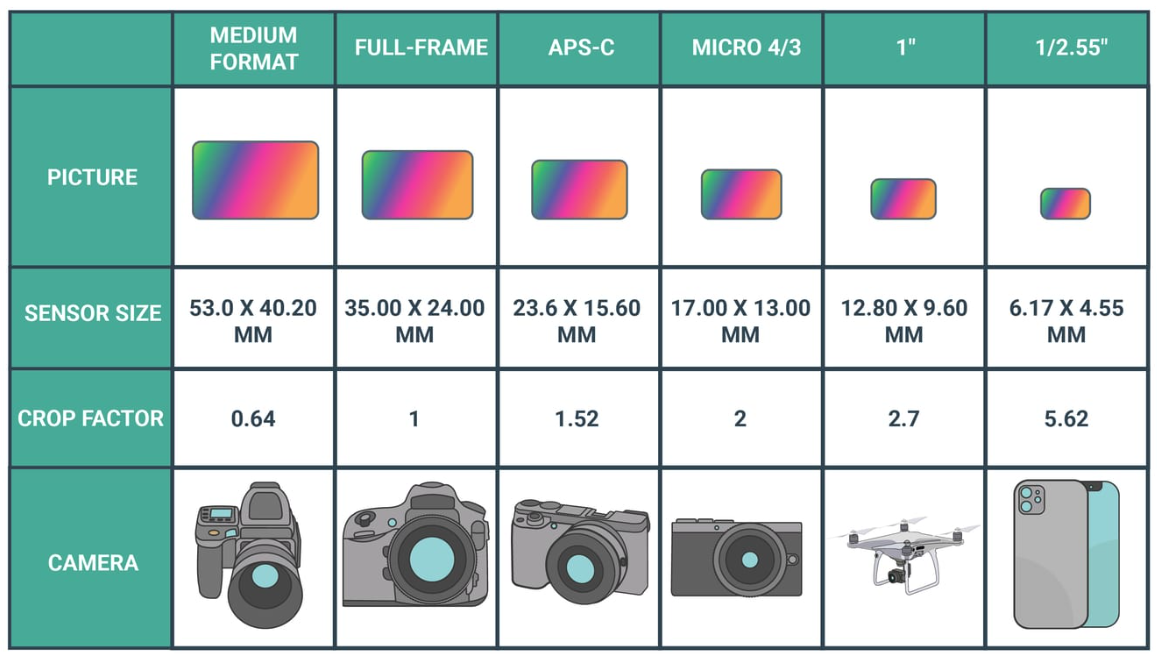
As for videography, full-frame, APS-C, and 1-inch sensors are acceptable. The recording devices should support at least 4K resolution. Again, if your wedding is happening at night, you want full-frame or APS-C recorders. Sometimes you will see videographers using cellphones; that is okay only if that is not their main device. You can ask Google: "Is the Canon C80 Netflix approved?" You want a Netflix-approved device for video recording. Netflix has high standards for video quality, and it has become a benchmark for high-quality recordings.
The following popular cameras have a cropped sensor:
- Canon EOS R7
- Canon EOS R10
- Canon EOS 90D
- Sony A6700
- Sony ZV-E10
- Fujifilm X-T5
- Fujifilm X-S20
- Nikon Z50 II
- Nikon D7500
The following are popular cameras with a full-frame sensor:
- Canon EOS R6 Mark I, II & III
- Canon EOS R5 Mark I & II
- Canon EOS R3
- Sony A7 IV
- Sony A7S III
- Sony A1
- Nikon Z6 III
- Nikon Z8
- Nikon Z9
- Panasonic Lumix S5 II
- Panasonic Lumix S1R II
The following are popular cameras with a medium-format sensor:
- Fujifilm GFX100 II
- Fujifilm GFX100S II
- Fujifilm GFX50S II
- Hasselblad X2D 100C
- Phase One XF IQ4
Double Memory Card
There is a second and very important aspect. Just remember, there is only ONE chance to capture the first kiss, the vows, the first dance, and emotional reactions! There is no retake here. The main cameras your photographer will use must have dual-slot memory card slots. There are a lot of horror stories about memory cards failing; the last thing you want is this. There are no second chances here.
The following popular cameras provide a cropped sensor with dual slot memory:
- Canon EOS R7
- Fujifilm X-T5
- Fujifilm X-H2
- Fujifilm X0H2S
- Sony A5700
The following popular cameras not only have a full-frame sensor, but also provide dual slot memory:
- Canon EOS R6 Mark I, II & III
- Canon EOS R5 Mark I & II
- Canon EOS R3
- Canon EOS 5D Mark IV
- Sony A7 IV
- Sony A7R V
- Sony A9 III
- Sony A1
- Nikon Z6 III
- Nikon Z8
- Nikon Z9
- Nikon D850
- Panasonic Lumix S5 II
- Panasonic Lumix S1R II
And finally, popular cameras with a medium format sensor and dual slot memory:
- Fujifilm GFX100 II
- Fujifilm GFX100S II
- Hasselblad X2D 100C
Release Date
Least important, but it could be a tie breaker if you are still undecided. Technology advances with time, and cameras are no exception. Recent models deliver better colours, less noise, more detail, and they are less likely to fail. You can ask Google when a specific gear was released: "What year was the Canon R5 Mark II released?" You want to avoid devices released more than 8 years ago.
Business Conditions
Here comes the most interesting part, where your negotiating skills come into play. Here are some of the many things you may want to discuss with your photographer.
Booking & Cancellation Policies
This point is a big one. You may want to know how to book the day. Some photographers may ask for a non-refundable payment up front (aka retainer). Sadly, when people book without a partial payment because there is no financial consequence, they usually cancel at the last minute, leaving the hired team high and dry.
You may also want to know what happens if you cancel or if the photographer cancels. Usually, if you cancel, you lose the non-refundable upfront payment, end of the story. If the photographer cancels, you must have your money back.
To Sign or Not To Sign a Contract
Before going to this part, you should have done your due diligence and had a friendly conversation with the photographer. As weird as it sounds, this is all about chemistry.
Signing a Contract binds the two parties to deliver a specific work for a specified price. So, here are some pros and cons of having a contract and not having one.
Pros of having a contract:
- It specifies every detail of the hired service.
- You know what to expect.
- The pricing is specified.
- You can sue if the work doesn't satisfy the contract requirements.
- You can specify how both parties will use the recorded material.
Cons of having a contract:
- It is hard to get flexibility: not a single minute of extra coverage, not a single extra photo. If your contract specifies the coverage starts at 2 pm, the team will start working as agreed. However, we all know that dealing with people is hard, and there are always situations where the newlyweds have no control. If the contract you signed doesn't specify a flexible adjustment, a photographer may stop working at 5 pm if the contract specifies that, leaving you hanging.
- The price may increase because signing a contract creates a legal obligation. The hired team will need to take additional measures that will affect the price. For example: hiring an event insurance.
Pros of not having a contract:
- Flexibility. If an unforeseen event happens, you can always negotiate with the team.
- The price is usually lower than under a contract.
Cons of not having a contract:
- Worst-case scenario: you won't get what you agreed. But this doesn't always happen, which is why you need to do due diligence.
Not signing a contract looks very appealing because of the lower possible price and the flexibility it offers. If you are planning to go for this route, please ask around. Don't be shy and ask for referrals.
We hope this guide helps, and we look forward to covering your wedding.
