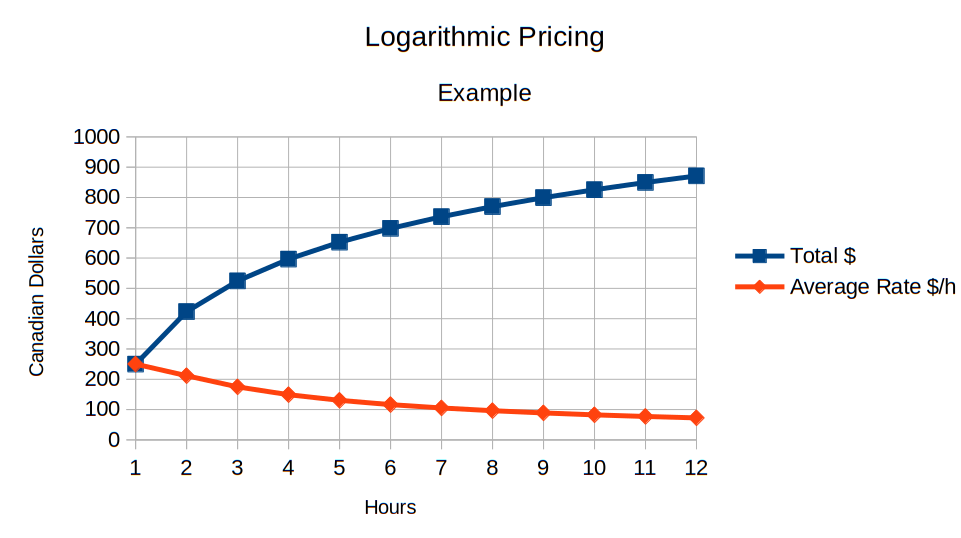
It is very common for photography/videography customers to get a flat rate per hour when requesting coverage for multi-hour events. And why not? It is easy to understand. However, there is a tradeoff when using this approach: expensive pricing. Why? Because 10 hours of work doesn't imply 10 times the effort of one hour of work doing the same thing. It is only fair that you pay what is fair within reason.
Because of this, we are introducing our logarithmic pricing scheme. This article will try to explain it. Do not worry; we will provide reference tables for each service.
The more Hours, the cheaper the Rate
| Hired Hours (h) | Total $ (p) | Average Rate $/hr | Discount from the last hour | Discount from the first hour |
|---|---|---|---|---|
| 1 | 250 | 250 | 0% | 0% |
| 2 | 423 | 212 | 30,69% | 30,69% |
| 3 | 525 | 175 | 41.50% | 59,45% |
| 4 | 597 | 149 | 29,05% | 71,23% |
| 5 | 652 | 130 | 22,43% | 77,69% |
| 6 | 698 | 116 | 18,29% | 81,77% |
| 7 | 736 | 105 | 15,45% | 84,58% |
Where:
- Hired Hours are the billed hours of work
- The total $ is the bill. We set the first hour and the following hours through the formal p(h) = p1 * (1 + ln(h)). P1 is the base price of 1 worked hour.
- Average Rate is the result of p / h.
- The discount from the last hour is the percentage discounted of the nth hour, considering the last hr increment. For example, in the second hour of work, the total bill is for 423. Meaning that the second hour is billed at 173. This means the second hour has a 30,69% discount if you compare against the last hour.
- The discount from the first hour is similar. It is the percentage discount of the nth hour considering the first hour. For example, in the third hour of work, the total bill is 525. The third hour is billed at 101, it has 59,45% off if you compare the first hour rate.
Don't worry, we will provide simple tables for your convenience.
